how to read a motor nameplate
When dealing with motors, whether it's for maintenance, installation, or just general knowledge, understanding the information provided on the motor nameplate is crucial. The motor nameplate is usually located on the side or top of the motor and contains important parameters such as the model number, power and speed of the motor. Here's a guide on how to read a motor nameplate and interpret the information provided.
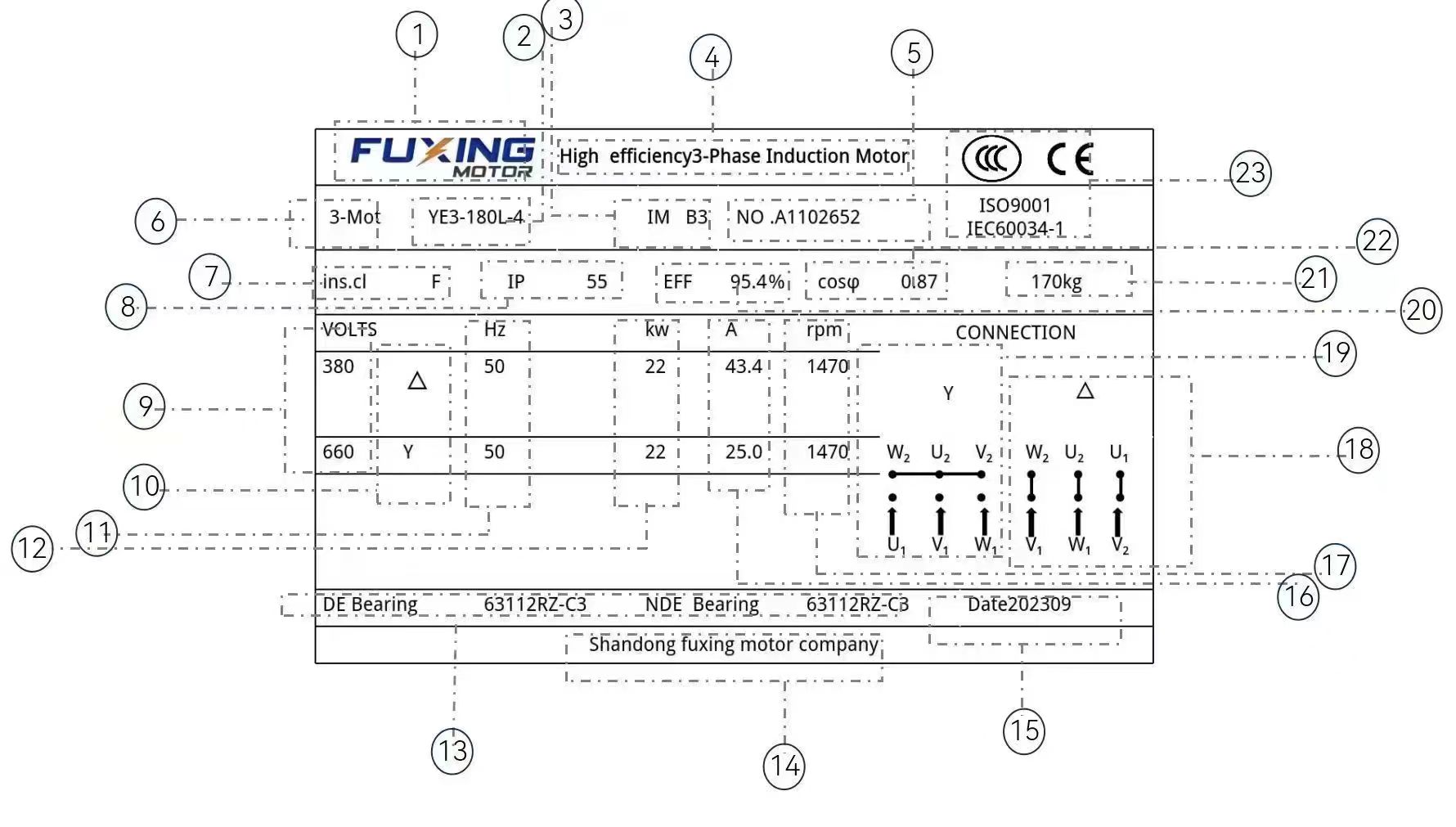
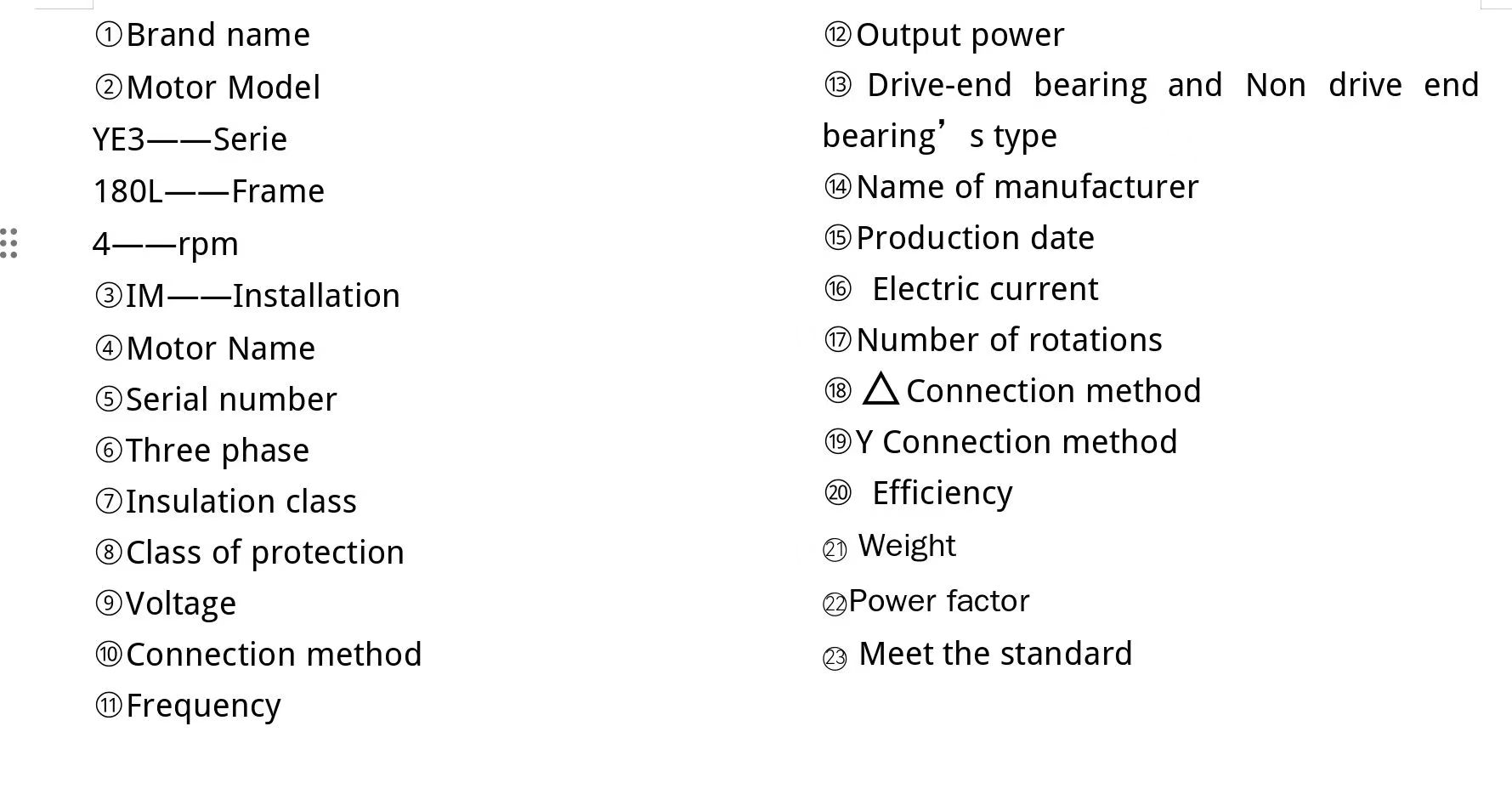
1. Manufacturer and Model Information
The nameplate usually begins with the manufacturer's name and logo, followed by the motor model number, speed, voltage, and mounting method. This information is crucial for referencing the manufacturer's manuals and specifications.
2. Voltage and Frequency
Next, you will find the voltage and frequency ratings of the motor. Voltage ratings indicate the range of voltages at which a motor can safely operate, usually 220V, 380V, 415V, 440V, 660V, etc. High voltage motors are available in 3,000V, 6,000V, and 10,000V, etc. Frequency ratings are available in either 50Hz or 60Hz, with the difference in frequency directly affecting the rotational speed.
3. Horsepower (HP)
The horsepower rating indicates the motor's mechanical output power. It's a measure of how much work the motor can perform. Different motors have different horsepower ratings, and selecting the right one for the application is essential. Usually, we will also use KW to show the output power of the motor, 1HP=0.7457KW for example 10HP=7.5KW ,15HP=11KW ,20HP=15KW We can convert to KW according to different HP.
4. Phase
The phase rating specifies the type of electrical supply the motor requires. Common ratings are single-phase and three-phase. Single-phase motors are typically used in smaller applications. Because single-phase motors have less torque than three-phase motors for the same output power, three-phase motors are more common in industrial environments.
5. Rotation
The rotation rating indicates the direction of rotation of the motor shaft when energised. It is important to match the rotation of the motor to the requirements of the application (e.g., pump or fan), and usually, with single-phase motors we can adjust forward and reverse rotation by adjusting the order of the wires at the junction box or by using a reversing switch.
6.RPM
The speed of a motor is usually determined by its model, there are 2P, 4P, 6P, 8P, 10P, 12P, the most commonly used is 2P/3000RPM, 4P/1500RPM, 6P/1000RPM, 8P/750RPM. this number is just a range value, will change with the size of the motor and the frequency, usually, the smaller the output power, the higher the speed, and the lower the output power, the higher the speed. The higher the output power, the slower the RPM.
7.Frame Size
The frame size rating represents the physical dimensions of the motor. The frame number represents the height from the ground to the center of the output shaft, e.g. a frame number of 132 means that the height from the ground to the center of the output shaft is 132mm.Different frame sizes have different mounting dimensions and shaft sizes, which must be compatible with the application. Of course, it does not exclude capacity-expanding motors, which can meet the customer's need to use a relatively large output motor in a small space.
8. Ambient Temperature
The rated ambient temperature specifies the maximum temperature at which the motor can be operated without overheating, which in general must not be higher than 70°C, and the altitude must not be higher than 1000 M. Consideration must be given to the environment in which the motor will be used to ensure that it can withstand the operating temperature.
9. Duty Rating
The duty rating indicates the type of duty cycle the motor can handle. Common ratings are continuous duty, intermittent duty, and short-time duty. The duty rating helps determine the motor's ability to withstand different operating conditions.
10. Service Factor
The service factor is a multiplier that indicates the motor's ability to operate safely at higher loads for short periods. It's a safety factor that helps protect the motor from overloading. We can also prevent damage due to motor overload by adding thermistors, etc.
11. Other Information
In addition to the above, the motor nameplate may include other information such as insulation class, series name, overall weight, and special markings.
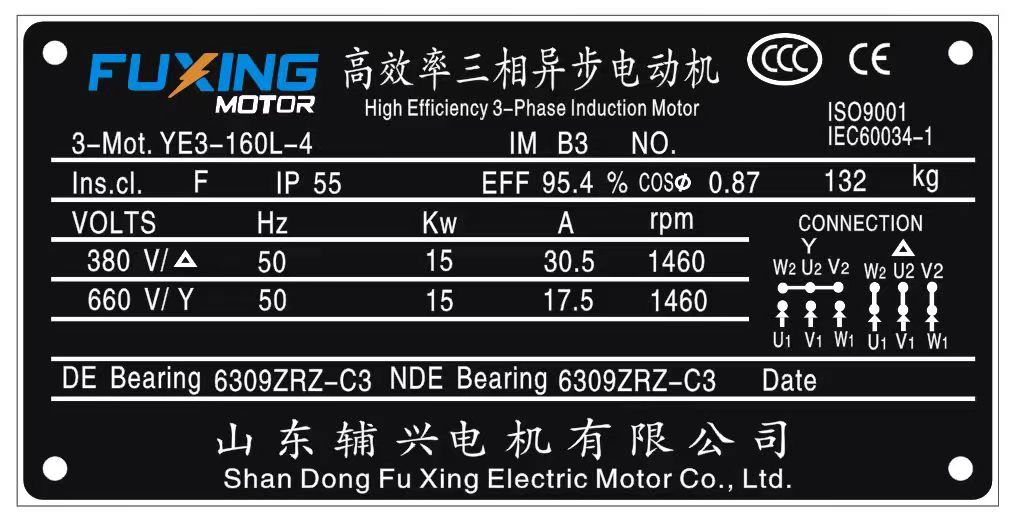
Are you ready? So now we have a small test! Here is a real motor nameplate, please tell me what information is marked on it.(The answer is at the end of the article, you can check it yourself.)
Reading and understanding a motor nameplate is an essential skill for anyone working with motors. By understanding the information provided on the nameplate, you can ensure that you select the right motor for your application and operate it safely and efficiently.
This is a nameplate of a 3-phase asynchronous motor produced by China Fuxing Motor, which clearly records that it is a YE3 (IE3) series 3-phase asynchronous motor with a center height of 160mm, an output power of 15KW, a speed of 1460 rpm, two wiring methods and corresponding voltage and frequency, a total weight of 132KG, an installation method of (B3) horizontal installation, insulation level of F, protection level of IP55, power of 95.4, power factor of 0.87, with EU CE certification and CCC certification, ISO9001 quality management system certificate, IEC60034-1 energy efficiency test report, produced by Shandong Fuxing Motor Co., Ltd. in China, and marked with production date and other information.