Three-phase asynchronous motor connection: star (Y) connection and delta (Δ) connection
Three-phase asynchronous motor is one of the most common motors in industrial production and daily life. It is widely used in various fields because of its high stability, simple structure and easy maintenance. The stator winding of the motor can be connected in different ways, mainly including star (Y) connection and delta (Δ) connection. These two connection methods directly affect the working voltage, starting characteristics and operating performance of the motor. In this article, we will introduce these two common types of motor winding connections in detail from three aspects: connection type, application, advantages and disadvantages, to help readers better understand their application scenarios and selection principles.
A. Connection Methods
1. Star (Y) connection
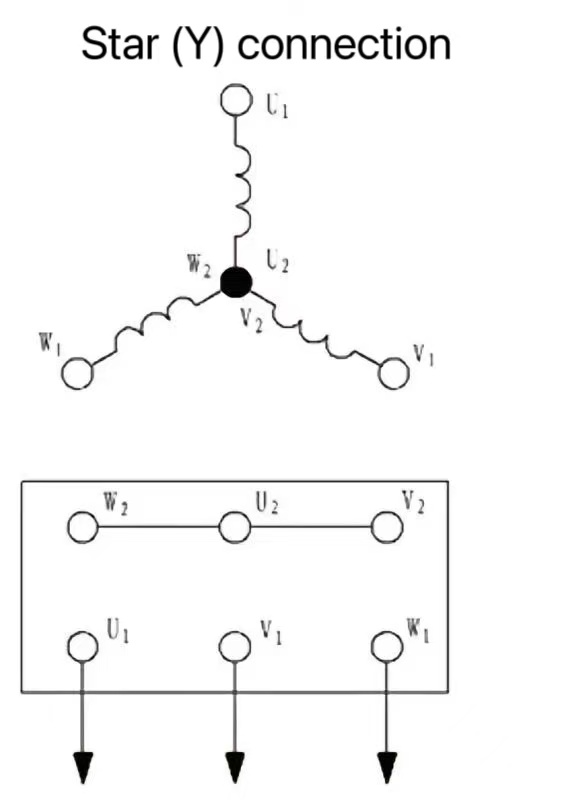
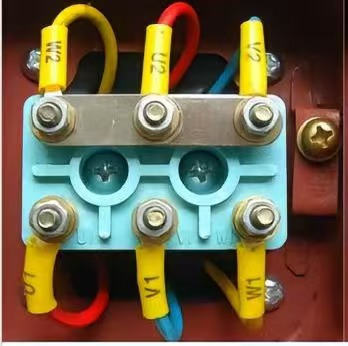
Star connection means that the three phases of the motor stator winding are connected to the three phases of the power supply (A, B, C) at the first end (U1, V1, W1), and the neutral point is formed by connecting the tail end (U2, V2, W2) to each other. This connection forms a circuit topology similar to the shape of a “Y” and is therefore called a star connection. 2.
2. Triangular (Δ) connection
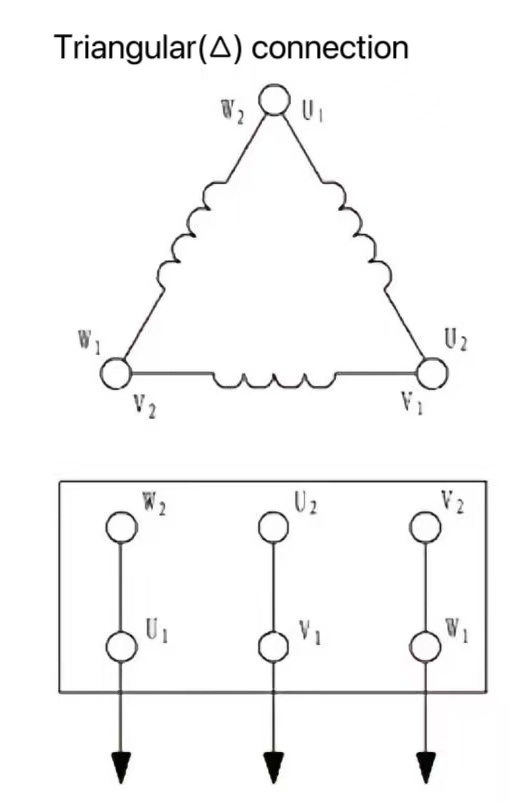
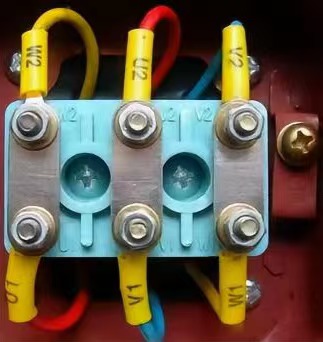
A delta connection is where the end of each phase of the stator winding of a motor is connected to the beginning of the other phase, i.e. U1 to W2, V1 to U2, W1 to V2, and then the three phases of the power supply are connected to U1, V1, W1, so that the windings form a closed triangle, and are therefore known as a delta connection.
B. Application
The selection of star and delta connection mainly depends on the design voltage of the motor, working environment and starting requirements.
1. Application of star (Y) connection
- Suitable for high voltage supply (e.g. motors with 660V or higher voltage).
- Suitable for occasions where the starting current is sensitive, e.g. where the load on the grid is high or the power supply capacity is limited.
- Suitable for light load starting occasions, such as fans, pumps and other equipment with small starting loads.
- It is mostly used for motors with small or medium power (generally less than 55kW).
2. Application of triangular (Δ) connection
- Suitable for low voltage supply (e.g. 380V motors).
- Suitable for applications requiring a high starting torque, e.g. air compressors, mixers, lifting equipment, etc. where starting with a load is required.
- Suitable for high power motors (typically over 55kW) to ensure higher output power at the rated voltage of the motor.
In addition, some motors with a rated voltage of **"△/Y 380V/660V ”** use a delta connection for 380V and a star connection for 660V to adapt to different power supply conditions.
C. Comparison of Advantages and Disadvantages
1. Advantages and disadvantages of star (Y) connection
✅ Advantages:
- Smaller starting current, which helps to reduce the impact on the grid.
- Suitable for high-voltage power supply, which can reduce the winding current and improve the service life of the motor.
- Stable operation, suitable for occasions where the load on the grid is more sensitive.
❌ Disadvantages:
- Smaller starting torque, not suitable for heavy load starting.
- Under the same supply voltage, the voltage at both ends of the winding is lower, resulting in lower motor output power.
- Not suitable for continuous operation of high power motors as the output power is relatively small.
2. Advantages and disadvantages of triangular (Δ) connection
✅ Advantages:
- Higher starting torque, suitable for starting with load.
- Higher voltage at both ends of the windings at the same supply voltage, enabling the motor to deliver a larger output power.
- Suitable for high power motors to increase the driving power of the equipment.
❌ Disadvantages:
- Higher starting current, which may have a greater impact on the power grid.
- Requires greater grid power supply capacity to meet the demands of high power operation.
- May not be suitable in some high voltage power supply applications.
D. Star-delta starting method (Y-Δ starting)
In order to utilize the advantages of the two connection methods, star-delta starting method is often used in some high-power motors:
1. During start-up, the motor is connected in star shape to reduce the start-up current and the impact on the grid.
2. After running, switch to delta connection to improve the motor output power and ensure the normal operation of the equipment.
The star-delta starting method is widely used for larger motors (e.g. 30kW and above) and is applicable to the case where the rated voltage of the motor is labeled as “△/Y 380V/660V”.
Conclusion
Star (Y) and delta (Δ) connections are the two main types of winding connections for three-phase asynchronous motors, and they differ significantly in terms of application scenarios, operating voltages and starting characteristics. The star connection is suitable for high voltage supply and light load starting, while the delta connection is suitable for low voltage supply and heavy load operation. In practical applications, it is necessary to select the appropriate connection method according to the rated voltage of the motor, load demand and grid conditions. In addition, for high-power motors, star-delta starting can be used to reduce the impact of starting current while ensuring the power demand during operation. Correct selection and use of motor connection methods will help to improve the operating efficiency of the equipment, extend the service life of the motor and optimise the utilisation of electrical energy.